Train the Trainer Program
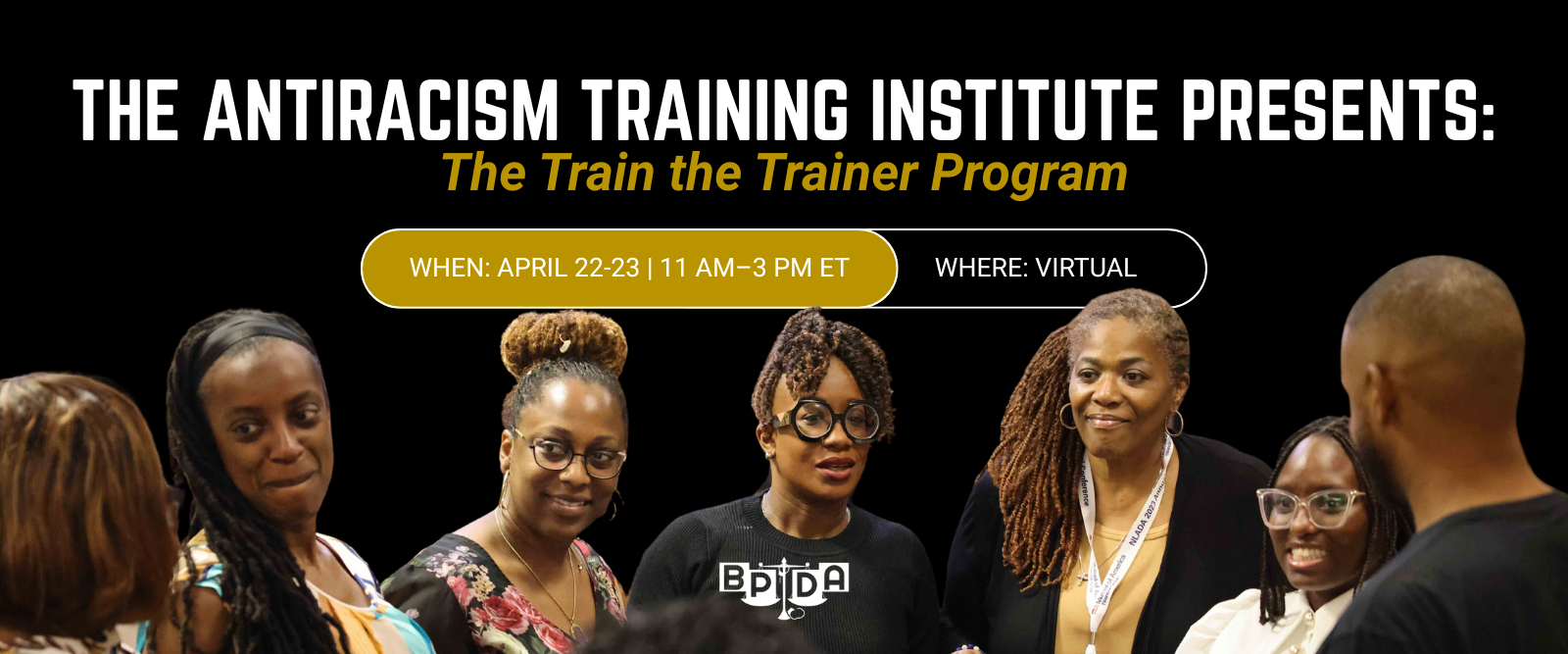
April 22 at 11:00 am – April 23 at 3:00 pm EST
Location: Virtual
The Black Public Defender Association Train the Trainer program is a two-day virtual intensive program designed for public defenders who develop and deliver training within their offices and professional communities. This program equips participants to design and facilitate training through a racial lens—starting from the premise that race is not an add-on to public defense work, but a structuring force that shapes law, practice, and institutional culture.
Rather than treating race as a discrete topic or specialized module, this training teaches participants to approach all training design decisions—learning objectives, content selection, hypotheticals, framing, and delivery—with deliberate attention to race and power. Participants will examine how seemingly neutral training choices—what cases we use, whose perspectives we center, how we frame problems—can reproduce racial hierarchy, and how antiracist design principles can be integrated from the outset to produce more honest, effective, and responsible training.
The program addresses both pre-training design and in-the-room facilitation, covering the role and responsibility of the trainer, principles of antiracist training design, and strategies for facilitating difficult conversations about race while managing power, resistance, and harm. Throughout, the focus remains on practical judgment, professional responsibility, and sustainability—so trainers can do this work well and keep doing it.
SCHEDULE
Please Note: The schedule is subject to change
DAY 1: Foundations and Design
April 22, 2026 | 11:00 AM – 3:00 PM ET
| 11:00-11:15 AM | Welcome, Framing, and Expectations Overview of program purpose, community agreements, expectations for participation, and how the two days will run. |
| 11:15 AM-12:45 PM | Session 1: Foundational Antiracism and the Trainer’s Role This session establishes core antiracist concepts, including structural vs. interpersonal racism, anti-Blackness as foundational, intersectionality, and race consciousness vs. colorblindness. It then situates public defender training as a site of institutional power and culture-setting, clarifying why race-neutral approaches reproduce harm and defining the trainer’s responsibility as culture-shaper rather than neutral skills vendor. |
| 12:45-1:00 PM | Break |
| 1:00-1:50 PM | Session 2: Designing Race-Conscious Training Content This session focuses on how to design training objectives that lead to changed practice, how to evaluate hypotheticals and case examples for racial harm, and how content selection, framing, and sequencing can either reinforce or disrupt racial hierarchy. Participants learn to center Black women, queer clients, and non-ideal folks while avoiding trauma porn and white savior narratives. |
| 1:50-2:00 PM | Break |
| 2:00-2:50 PM | Session 3: Adult Learning Principles This session examines traditional adult learning theory and its limitations. Participants learn to incorporate embodied learning, storytelling, lived experience, and emotional engagement as learning tools. |
| 2:50-3:00 PM | Day 1 Close Brief reflection and preview of Day 2. |
DAY 2: Facilitation, Power, and Accountability
April 23, 2026 | 11:00 AM – 3:00 PM ET
| 11:00-11:10 AM | Re-Entry and Grounding Brief reconnection to the purpose of the training, acknowledgment of fatigue, and re-centering of expectations for the day. |
| 11:10 AM-12:40 PM | Session 4: Facilitation, Power, and Responding to Harm This session addresses how trainers facilitate difficult conversations about race, recognize predictable resistance patterns, and respond to harm in real time. Participants examine trainer positionality (Black trainers in white offices, white trainers teaching race, supervisors training subordinates), learn to manage racialized power dynamics, including tone policing and credibility gaps, and practice responding to microaggressions, racist hypotheticals, and disrespectful client discussions. The session includes strategies for holding space and holding the line, determining when discomfort is productive versus harmful, and implementing co-training models that avoid exploitation. |
| 12:40-12:50 PM | Break |
| 12:50-1:50 PM | Session 5: Accountability, Boundaries, and Sustainability This session focuses on measuring impact beyond satisfaction surveys, exploring metrics that matter including behavior change, policy change, and client experience. Participants discuss what antiracist trainers should not compromise, strategies for setting boundaries to avoid tokenization and emotional overexposure, and approaches to sustaining this work over time without burnout. The session addresses knowing when to say no and when to walk away from institutions seeking optics over change. |
| 1:50-2:00 PM | Break |
| 1:50-2:00 PM | Closing and Accountability The program concludes with a synthesis of key takeaways, clarification of participant responsibilities moving forward, and introduction to the optional application lab. |
Optional Post-Intensive Application Lab
Proposed dates: May 27 and May 28, 11am -1pm EST; May 29, 12pm-2pm EST
Following the two-day intensive, participants will have the option to join a small-group application lab designed to support the practical implementation of the framework. This session is intended for participants who want focused feedback on how they translate the training into their own teaching practice.
In this optional session, participants will meet in small groups facilitated by trained group leaders. Each participant will present a 10-12 minute segment of a training they currently teach or plan to teach, with attention to framing, learning objectives, delivery choices, and facilitation decisions. Participants will then receive structured feedback grounded in the antiracist framework introduced during the intensive.
The application lab is practice-focused and time-bounded. It is not a lecture, a discussion of office-specific issues, or a space for personal processing. The goal is to provide concrete, actionable feedback that helps participants refine their training approach and strengthen their ability to deliver race-conscious, antiracist training within their offices.
Participation in the application lab is optional but strongly encouraged for trainers who regularly design or deliver trainings and want targeted support in applying the framework to real-world training scenarios.
Frequently Asked Questions
Can non-black public defenders attend?
Yes. We welcome defenders of all backgrounds who are committed to engaging thoughtfully in this work. This training encourages participants to approach public defense through an anti-racist lens—recognizing how race and power shape the criminal legal system and our advocacy. Rather than treating race as a separate topic, participants will examine how everyday training and advocacy decisions—such as the cases we highlight or the perspectives we center—can reinforce or challenge racial inequities.
Can investigators, social workers, and client advocates attend?
Yes. We define public defenders not just as attorneys but also as investigators, social workers, client advocates, policy advocates, and others working on the front lines to defend communities against mass incarceration. We welcome both emerging and current trainers in these roles to participate.
This program focuses on both training design and facilitation, including trainers’ responsibilities, principles of antiracist training design, and strategies for navigating challenging conversations about race while managing power, resistance, and harm. The goal is to equip participants with practical tools to lead effective and sustainable trainings.
Does BPDA partner with offices to provide training for their teams?
Yes. If you are interested in partnering with BPDA to bring a training to your office, please visit our Antiracism Training Institute page to learn more and fill out our form to schedule a training.
Do I need prior training experience?
No — this program is designed for both new and experienced trainers.
What will I learn?
How to design and facilitate trainings with race and power at the center.